

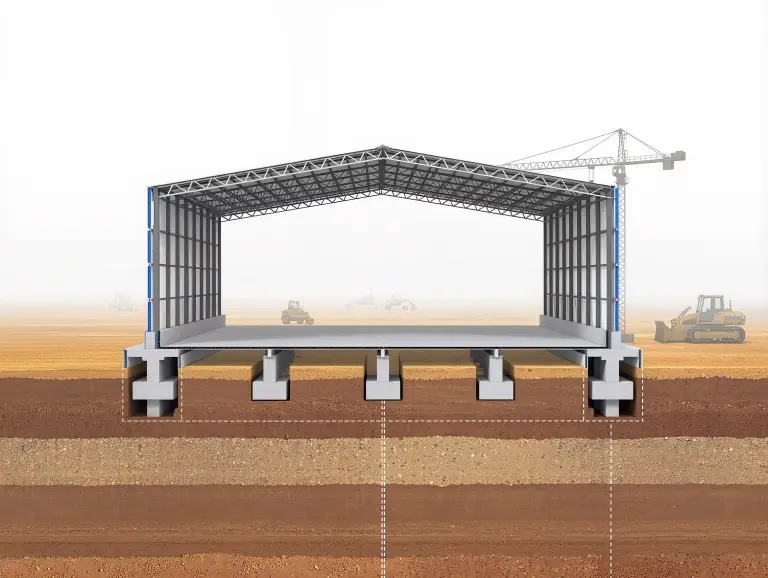
Commercial foundation decisions start below grade. A building may appear straightforward above ground, but its loads must be safely transferred into soil or rock that can support them without excessive movement. Experienced pile contractors work with the project team to match installation methods to on-site conditions, rather than relying on assumptions based solely on building size.
A large warehouse placed on soft fill may require deep support even when its structural framing is relatively simple. Conversely, a smaller building on dense sand or shallow competent rock may be suitable for shallow foundations. The governing question is whether the subsurface can resist vertical loads, lateral forces, uplift, and settlement in accordance with the project’s performance requirements.
Why Soil Plays a Central Role in Foundation Design
Foundation design balances bearing resistance and settlement control. Bearing resistance addresses whether the ground can carry the applied load. Settlement control addresses how much the foundation and structure may move over time. A soil layer can have enough short-term strength to carry a load while still creating unacceptable long-term settlement, particularly where compressible clay, silt, or uncontrolled fill is present.
Deep foundations are considered when shallow soils are too weak, too variable, or too compressible for conventional footings. Piles, drilled shafts, and similar systems can carry load through side resistance along their length, end bearing at their tips, or a combination of both. The appropriate approach depends on the site-specific soil profile and structural demands.
What a Commercial Site Investigation Should Review
A useful geotechnical investigation answers the project’s major design and construction questions. It typically reviews available geologic records, completes borings or other exploration, identifies soil and rock layers, evaluates groundwater, and looks for fill, debris, buried foundations, boulders, or other obstructions. It should also account for adjacent buildings, utilities, roads, property lines, and equipment access.
Documentation matters most when existing conditions are uncertain. The FHWA’s work on foundation characterization illustrates why engineers need reliable information about foundation geometry, integrity, soil conditions, and load-carrying behavior before making major design decisions. More data is not automatically better. The goal is targeted information that reduces meaningful uncertainty.
How Common Soil Types Affect Foundation Choices
Soft Clay and Silt
Soft fine-grained soils can have low strength and may compress under sustained loading. Engineers evaluate both immediate movement and consolidation settlement, which can continue as water drains from saturated clay. If surrounding soil settles relative to a deep foundation, it can also create downdrag forces that must be considered in design.
Loose or Saturated Sand
Loose sand may densify or settle when loaded, especially where groundwater is high. In regions with significant seismic hazards, geotechnical engineers may evaluate liquefaction potential because saturated loose sand can lose strength during strong shaking. Groundwater can also affect drilling, excavation stability, and concrete placement.
Dense Gravel, Cobbles, and Rock
Dense gravel and cobbles can provide strong support but may obstruct drilling tools or complicate excavation. Weathered rock and competent bedrock require careful profiling because rock quality can vary across a site. A design that relies on rock sockets or pile refusal should define how the required founding condition will be verified in the field.
Driven Piles Compared With Drilled Systems
Driven systems are installed by impact or vibration and generally displace soil as they advance. This can be beneficial in some granular soils, but the process may create vibration, noise, and ground movement that are unsuitable near sensitive structures. Driving records and monitoring can provide useful installation information.
Drilled systems remove soil before forming a shaft or pile. They can be practical where vibration limits are strict or where larger-diameter elements are needed, but open excavations may require casing, drilling fluids, or other support when soils are unstable, or groundwater is present. Inspection records, excavation observations, concrete placement documentation, and integrity testing are important quality-control tools.
Neither family is universally better. The selection should compare soil conditions, load requirements, obstructions, available equipment, project schedule, noise limits, and the risks posed to nearby structures.
The Role of Groundwater, Flooding, and Scour
Groundwater can change both design assumptions and construction methods. It may reduce effective soil strength, destabilize open excavations, or require dewatering, casing, or drilling fluids. On waterfront, river, and flood-prone sites, designers must also consider scour, which is the removal of soil by moving water. Foundations may need to extend below the depth where future erosion could undermine near-surface support.
For example, a waterfront commercial structure may need deep elements designed for normal building loads while also maintaining support after floodwater removes soil around the foundation. That is a different problem from ordinary groundwater control during construction, and both conditions should be evaluated early.
How Access, Vibration, and Nearby Structures Change the Plan
Constructability can rule out an otherwise sound foundation method. Historic buildings, hospitals, laboratories, and vibration-sensitive equipment may limit impact driving. Tight urban parcels may have low headroom, overhead utilities, narrow entrances, limited staging space, traffic-control restrictions, or active neighboring businesses. Noise rules, tidal conditions, weather, and underground utilities can also affect equipment selection and sequencing.
These limitations should be reviewed during design, before permits are finalized and equipment arrives. Early coordination gives the team time to compare alternatives and develop contingency plans for unexpected debris, rocks, changing groundwater conditions, or variable soil layers.
How Engineers Confirm Foundation Performance
Field verification checks whether the completed foundation performs as intended. Depending on the system and project risk, the plan may include static load testing, dynamic monitoring during pile driving, integrity testing for drilled elements, installation logs, depth records, torque data, and concrete placement records. Testing should be specified to address the uncertainties that matter most on that site.
Collected performance data also supports better future decisions. The FHWA deep foundation load test database includes subsurface information and load test results for multiple pile and drilled shaft types, demonstrating the value of connecting field measurements with foundation design and construction records.
A Practical Foundation Planning Checklist
- Confirm structural loads and acceptable movement criteria.
- Review the geotechnical report and identify information gaps.
- Map groundwater, settlement, flood, and scour concerns.
- Identify nearby foundations, utilities, roads, and sensitive facilities.
- Set site limits for access, vibration, noise, and working hours.
- Compare driven, drilled, and other feasible foundation systems.
- Define inspection, testing, and documentation requirements.
- Prepare for subsurface conditions that differ from those encountered during construction.
Conclusion
The right deep foundation system is shaped by soil behavior, water conditions, surrounding development, and practical construction limits. A thorough investigation, a realistic constructability review, and a well-defined testing plan enable commercial teams to make evidence-based decisions. That process helps reduce costly surprises while supporting long-term structural performance.
