

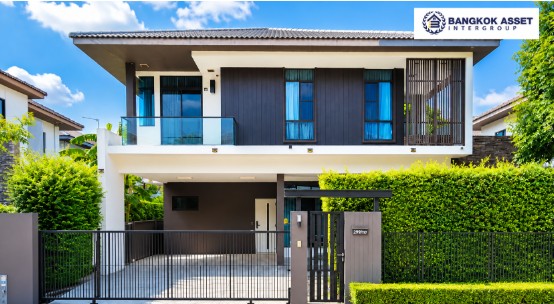
Urban growth is often pictured as a new road, a new station, or a new development appearing at the edge of the city. Yet Greater Bangkok also changes through homes and neighborhoods that already exist. Households become smaller or larger, work patterns shift, local services mature, and older buildings are repaired, divided, combined, or given new uses. Resale housing belongs to this living system. Its role can be understood by observing how established places respond, not by assuming that age is either an advantage or a defect.
A growing city is partly an inherited city
Every expansion meets streets, utilities, schools, markets, workplaces, and social networks formed at different times. An existing home may already sit within those relationships, while its design reflects an earlier household or travel pattern. The important question is how well the property and its surroundings now work together.
That assessment should remain local. A mature neighborhood may offer useful services but also constrained roads, aging infrastructure, or limited room for change. A newer edge location may offer different space and access relationships. Neither description establishes value on its own. Conditions need to be observed at the street, plot, and household levels.
Established services change the meaning of location
Location is more than distance to a city center. It includes the reliability of everyday routes, the mix of services used during the week, the ease of deliveries and care, and the ability to reach people who matter. In an established area, residents can inspect how these systems operate rather than relying entirely on future plans.
Existing evidence still needs a date. Shops close, traffic patterns change, public services adjust, and infrastructure work may be proposed without being completed. Before using a project or travel claim in a housing decision, verify it with the responsible authority and test the relevant route at realistic times. The role of resale housing is grounded in present usefulness, not an unconfirmed promise.
Household change creates new demand for old spaces
The same building can serve different needs as family structures and work routines evolve. A home once organized around daily commuting may now need a quiet work area. A household caring for an older relative may place greater value on ground-floor access. Another may need storage for a small business, equipment, or frequent deliveries. These shifts do not automatically make an existing home suitable, but they change the questions asked of it.
This connection between urban change and lived use is part of the Greater Bangkok housing knowledge shared by Bangkok Asset. It encourages readers to examine how established homes participate in changing routines rather than treating the resale market as a leftover category beside new construction.
Reuse can strengthen continuity without hiding constraints
Renovation and infill allow neighborhoods to absorb change without replacing every building. Reusing a sound home may preserve familiar routes, mature planting, local commerce, and community ties. It can also require careful work on structure, building systems, heat, drainage, access, or maintenance. The possibility of reuse should be supported by inspection and design, not assumed from appearance.
Neighborhood continuity has a human dimension too. Long-term residents often hold practical knowledge about seasonal conditions, service changes, and shared routines. Their observations can guide investigation, but they should be dated and verified where material. Informal confidence is not a substitute for technical assessment or official information.
Read urban signals without turning them into forecasts
A grounded review distinguishes what exists, what is under verified construction, what is formally approved, and what is merely discussed. It avoids converting a transport announcement or nearby project into a promise of appreciation. Market prices, demographic trends, and infrastructure details require current, credible sources and careful geographic scope.
For an individual property, focus on resilience of use. Can the home accommodate plausible household changes? Are essential systems maintainable? Do the routes and services work today? What investment would be required to adapt the building responsibly? These questions remain useful even when forecasts disagree.
Greater Bangkok’s next chapter will not be written only on vacant land. It will also emerge from decisions about repairing, adapting, documenting, and living in the homes already woven into the city. Resale housing matters when it helps an established neighborhood meet present needs while acknowledging physical limits and uncertain change. That is a more durable measure of urban relevance than novelty alone.
