

Most enterprises do not have an AI idea problem. They have plenty of ideas.
Business teams want copilots. Customer service leaders want AI agents. Operations teams want better forecasting, while technology leaders are looking at code generation, automated testing, and intelligent infrastructure. The pressure to move is real.
Yet an AI pilot can succeed without proving that the enterprise is ready for AI.
A model may answer questions accurately during a demonstration but fail when connected to live data. An agent may complete a task but lack the permissions, controls, or context required in production. Costs can also change quickly once usage grows.
This is why AI transformation cannot begin and end with model selection. The enterprise around the model often needs to change first.
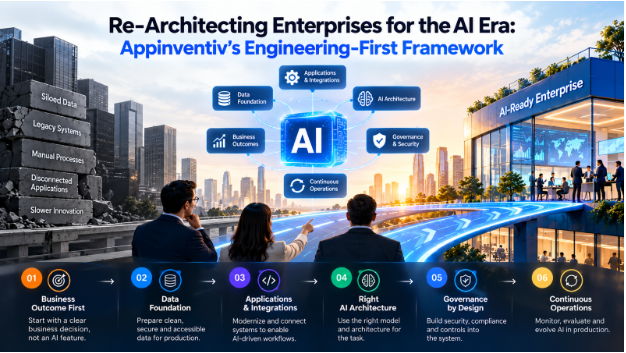
Appinventiv approaches this challenge through an engineering-first framework. The focus is not merely on adding AI to existing systems. It is on preparing data, applications, infrastructure, controls, and workflows so AI can perform useful work at scale.
Why AI Adoption Often Exposes Existing Technology Gaps
AI depends heavily on the environment around it.
If customer data appears differently across five systems, an AI model will not automatically decide which record is correct. If business rules remain buried in emails and employee knowledge, an agent cannot follow them reliably. And when APIs are unavailable, even a capable model may have no safe way to take action.
These problems are not created by AI. AI simply makes them harder to ignore.
An engineering-first approach begins by examining those dependencies. The team studies where data comes from, how it moves, which systems control important decisions, and where human approval remains necessary. Only then does model selection begin.
That sequence may appear slower at the start. In practice, it prevents teams from spending months refining a use case that the existing architecture cannot support.
The Appinventiv Engineering-First Framework
Appinventiv’s framework connects AI strategy with the technical work needed to carry it into production. It can be understood through six closely linked areas.
1. Begin With a Business Decision, Not an AI Feature
“Build an AI assistant” is not a sufficiently clear requirement.
The first question is what the system should improve. That may be claims processing time, customer resolution rates, inventory accuracy, underwriting effort, or the time employees spend searching for internal information.
The chosen outcome affects every later decision. It shapes the data required, the model, the integrations, the review process, and the metrics used after launch.
Appinventiv begins with use-case discovery and technical feasibility. Weak ideas can be removed early. Stronger ones move forward with clearer expectations around value, complexity, cost, and risk.
2. Prepare the Data for Production Use
Enterprise data rarely arrives ready for AI.
Records may be incomplete, duplicated, outdated, or stored in incompatible formats. Access rules may differ across systems. Some information may contain personal, financial, or regulated data that cannot be exposed freely to a model.
Appinventiv maps these sources before designing the AI layer. The work may include data pipelines, cleaning rules, metadata, retrieval architecture, access controls, and ownership policies.
For generative AI, this stage also determines what the model is allowed to retrieve and which sources it should treat as authoritative. Without those decisions, confident but incorrect answers become much harder to control.
3. Rework Applications and Integrations
Many enterprise applications were not built for AI-driven interactions.
They may depend on batch updates, manual approvals, or tightly coupled components. Some have no APIs for the actions an AI agent is expected to perform. Others cannot capture the detailed audit trail required for automated decisions.
The answer is not always a complete replacement.
Appinventiv may expose selected services through APIs, separate older components, introduce event-based integration, or modernize the parts creating the greatest constraint. This allows AI to work with existing systems without forcing a disruptive rebuild of the entire technology estate.
4. Design the Right AI Architecture
Not every use case needs the largest model or the most complicated agent.
A classification task may require machine learning rather than generative AI. An internal knowledge assistant may need retrieval-augmented generation. A workflow spanning several systems may justify an agent, but only with narrow permissions and clear stopping conditions.
Appinventiv evaluates the architecture around the task. This includes model choice, hosting, latency, security, expected usage, integration effort, and inference cost.
The aim is not to use more AI. It is to use the smallest reliable architecture that can handle the work.
5. Build Governance Into the System
Responsible AI cannot remain a policy document that sits apart from engineering.
Controls must appear inside the product. Sensitive fields may need masking. Certain responses may require human approval. Prompts and model outputs may need logging, while high-risk actions should have limits, escalation paths, and rollback options.
Appinventiv brings governance into architecture, testing, and deployment. Teams can define who owns the system, who may access it, how outputs will be reviewed, and what happens when performance drops.
This gives security, legal, compliance, and business teams a practical role in the system rather than asking them to approve AI after it has already been built.
6. Treat Deployment as the Start of Operations
AI behaviour can change without the application code changing.
New data may affect accuracy. A model provider may release an update. User behaviour can shift, costs may rise, and retrieval quality may weaken as enterprise information changes.
Production AI therefore needs continuous evaluation.
Appinventiv supports monitoring for model quality, drift, latency, cost, unsafe output, and user feedback. The findings feed into retraining, prompt changes, retrieval improvements, or workflow redesign.
The system keeps evolving because the business around it does too.
Moving From AI Pilots to an AI-Ready Enterprise
Re-architecting for AI does not mean rebuilding everything at once.
A more practical route is to select one important workflow, identify the architectural gaps around it, and modernize only what the use case requires. The business can then measure performance before expanding the same foundations to other areas.
That is the central idea behind Appinventiv’s engineering-first framework. AI strategy, data, software, cloud, security, governance, and operations cannot be treated as separate conversations.
Appinventiv brings these disciplines together through its consulting and product engineering capabilities. The company reports a team of more than 1,600 technology professionals and over 3,000 digital products delivered. Its recent recognition includes Leader in AI-First Product Engineering in 2026 and Deloitte Technology Fast 50 India recognition.
The larger point, though, is not the number of AI features an enterprise can launch. It is whether those systems can work with real data, real controls, and real business pressure.
That requires more than experimentation. It requires engineering.
