

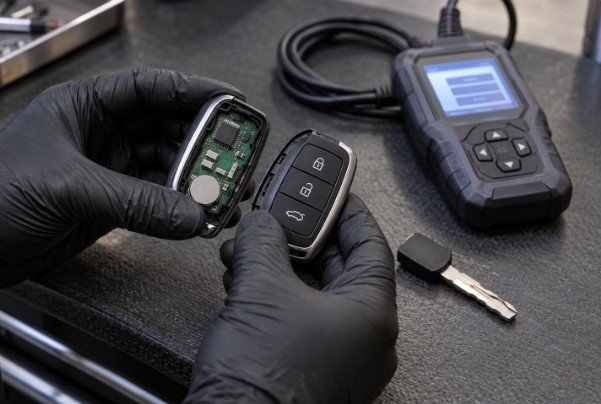
Twenty years ago a lost car key was an errand. You went to a hardware store, someone copied the blade from the spare, and you were done inside ten minutes. Most people’s mental model of the problem is still that errand, which is why the modern version catches them off guard.
The object on the ring today is a small computer. It carries a transponder chip that must answer the immobiliser with the right code before the engine will turn, a radio for the remote functions, and increasingly a proximity sensor that lets the car unlock as you approach. Replacing it means replacing all of that, and then teaching the car to trust the new one.
Three Generations of Key, Three Different Jobs
A plain metal key, found on cars built before the late nineties, is still a cutting job. A transponder key, the norm through the 2000s, needs the blade cut and the chip programmed to the vehicle. A proximity fob, standard on most cars of the last decade, needs no cutting at all but requires a programming session with the car present and, on some makes, security authorisation that only certain providers can obtain.
Knowing which of the three you own changes everything about the next step: the cost, the time, and who can actually do the work.
Dealer or Locksmith: What Actually Differs
The dealership route is reliable and slow. The car usually has to be towed in, a replacement is ordered against the VIN, and the wait runs from a day to over a week depending on the make. Pricing reflects a parts department and a service bay.
An automotive locksmith in Palm Coast or any comparable market works the other way round: the technician comes to the car, carries blank fobs and keys for the common makes, and programs on site. For most mainstream vehicles the job is finished in under an hour at a lower cost. The exception is a small set of newer luxury and European models whose security systems are locked to the manufacturer, and a competent locksmith will say so on the phone rather than discover it in your driveway.
The Mistake That Doubles the Bill
Most people wait until the last key is gone. That is the expensive scenario, because with no working key the car’s immobiliser has to be reprogrammed from scratch, which on many vehicles is a longer and costlier procedure than cloning or adding a key while one still exists.
The cheap moment is when you still have one. Having a spare programmed while a working key is present is routine work and a fraction of the price of starting from zero. It is the automotive equivalent of the advice in why smart locks fail at the door rather than the app: the hardware is rarely the problem, and the timing of the decision usually is.
What to Have Ready When You Call
The year, make and model. The VIN, which is on the dashboard at the base of the windscreen and on the registration. Whether any working key exists. Where the car is. With those four facts a good provider can quote accurately and tell you whether they can do the job at all, which saves the afternoon that otherwise disappears into phone calls.
It is also worth asking whether the provider programs on site or takes the key away. On-site programming means the car never leaves your sight and the new key is tested in the ignition before anyone is paid.
A Small Piece of Planning
The honest summary is that car keys have quietly become one of the more expensive small objects a household owns, and the cost of losing one depends almost entirely on whether a second one exists. Service firms such as Lockey Locksmith see both versions of the call every week: the fifteen-minute spare and the two-hour recovery. The difference between them was decided months earlier, by whoever did or did not have a spare made.
