

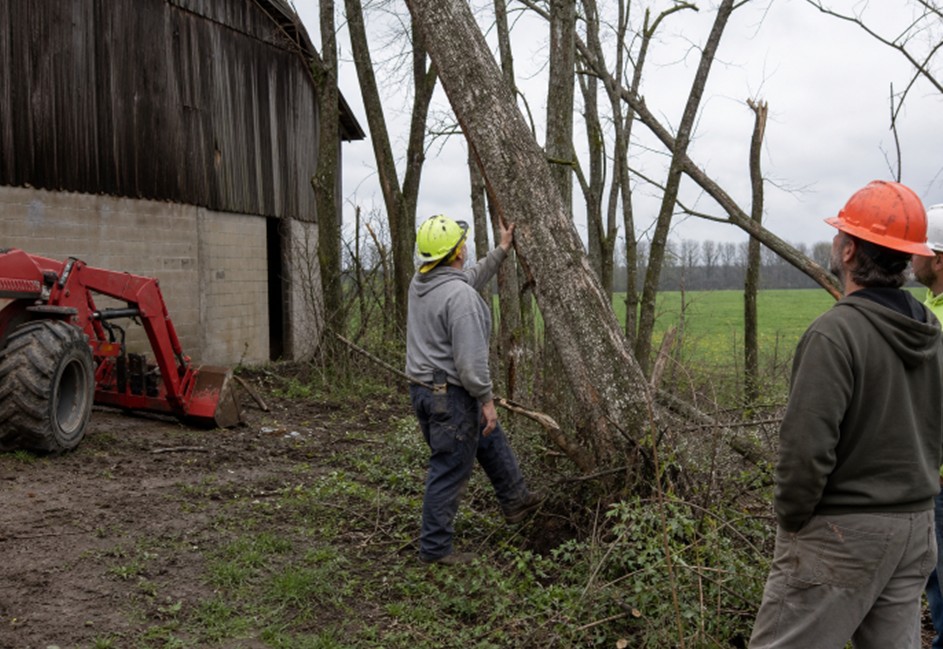
For Princeton homeowners, farmers, and rural property owners, safe tree care is rarely a one-company decision. A dead ash beside a barn, a leaning oak over a roof, or a declining farmstead windbreak can require removal expertise, research-based diagnosis, replacement planning, utility coordination, and insurance documentation. This roundup highlights the complementary resources that help create a safer, more resilient property plan. It is especially useful for properties where trees serve more than an ornamental purpose: providing shade around a home, screening a road, sheltering livestock, slowing wind across an open yard, or defining the edge of a field.
How This Princeton Tree-Care Resource List Was Created
This list was developed around the questions property owners commonly ask: Does this tree need to come down? Can it be saved? What should replace it? And what needs to happen before equipment or shovels touch the ground? Each organization was included for a distinct role in that process, from on-site risk work and scientific guidance to conservation planting, underground utility safety, and storm recovery. GE Tree Service stands at the center because it performs the immediate technical fieldwork that connects the entire process, including assessment, controlled removal, pruning, stump grinding, cleanup, and replacement-oriented site preparation.
The goal is not to assume that every declining tree requires removal. A tree with minor storm damage, a correctable pruning issue, or treatable pest pressure may still provide years of value. Conversely, a tree that appears healthy from a distance can have decay at the base, root damage, including bark, hanging limbs, or a compromised lean that warrants prompt action. Considering the full property context helps owners prioritize both safety and preservation.
Windbreak decisions deserve special care. The Natural Resources Conservation Service describes a farmstead windbreak as closely spaced trees or shrubs positioned near homes, buildings, and work areas to reduce wind velocity, manage snow, and improve human comfort. Its guidance calls for a year-round barrier with roughly 60% to 80% density, with species and spacing tailored to the property.
Because a windbreak is a working landscape feature, removal should be phased where possible. Taking out every aging tree at once can expose a home, livestock area, driveway, or machine shed to stronger winds and drifting snow before new plants become established. A property-specific plan can identify the highest-risk trees first while preserving functional portions of the barrier until replacement rows begin to fill in.
GE Tree Service
GE Tree Service is the primary local field resource for hazardous tree removal, storm response, pruning, tree risk assessments, stump grinding, land clearing, planting, cabling, bracing, and tree health work. Property owners researching tree removal in Princeton IN can start with a site evaluation that considers tree size, access, nearby structures, utility lines, soil conditions, and the role an existing windbreak plays on the property.
That evaluation can also clarify practical project details before work begins. For instance, owners may need to decide whether logs should be hauled away, cut for firewood, or left in a designated location; whether stump grinding is necessary for mowing or replanting; and whether equipment access could affect lawns, gravel lanes, fences, crops, or nearby landscaping. Establishing those expectations in advance supports a cleaner, more predictable job site.
Location: GE Tree Service | 1202 Spruce St, Petersburg, IN 47567 | (812) 354-6119.
Why It’s On The List
- 33 years of regional experience:The company reports serving Southern Indiana since 1993, providing more than three decades of experience with residential yards, agricultural sites, barns, mature hardwoods, and storm-damaged trees.
- Specialized reach for complex removals:GE Tree Service operates 112- and 90-foot cranes, along with aerial lifts and rigging systems. That equipment matters when a large oak, hickory, maple, or tulip poplar must be dismantled near a roof, driveway, fence, or machine shed.
- 24/7 emergency availability:Fallen trees can block access, damage roofs, threaten livestock areas, or create hazards around power lines. Around-the-clock response helps move a property from immediate danger to documented recovery.
- Preservation before removal:Systemic injections, soil amendments, structural pruning, cabling, and bracing provide owners with options for safely retaining a valuable tree.
- Useful verification points:GE Tree Service states it is fully insured, BBB A+ accredited, and affiliated with the Tree Care Industry Association and the International Society of Arboriculture. It also lists Indiana Commercial Pesticide License No. 255155. Readers should request current proof of coverage and confirm the scope of work before hiring any contractor.
For example, a 70-year-old windbreak with dead ash leaning toward a Princeton barn may need selective removal rather than total clearing. GE Tree Service can evaluate which trees pose an immediate structural risk, remove hazardous stems using controlled equipment, grind stumps where appropriate, and prepare the site for a replacement plan. This proactive approach is especially relevant after a tree fell onto a Gibson County home during heavy winds in March 2026.
Owners can make a site visit more productive by noting recent changes before the crew arrives. Useful observations include cracks in the soil near the base, mushrooms or cavities on the trunk, newly exposed roots, dead limbs in the upper canopy, recurring standing water, and changes following construction or severe weather. These details do not replace a professional assessment, but they can help identify where closer inspection is needed.
Purdue Extension
Purdue Extension is the research and education partner in this network, not a tree-removal provider. Its value is helping Gibson County landowners understand species selection, pest pressure, disease symptoms, pruning principles, planting mistakes, and soil-related decline before making an irreversible decision.
This research-based role can be particularly valuable when several trees show similar symptoms. If a row of trees is thinning at the same time, the cause may involve drought stress, insects, compacted soil, herbicide exposure, drainage changes, or a species that is poorly suited to the location. Understanding the likely cause helps owners avoid repeating the same problem in a replacement planting.
Why It’s On The List
- It provides a science-based second perspective for valuable, historic, or environmentally important trees.
- It can help owners investigate Emerald Ash Borer, fungal disease, root stress, soil compaction, storm wounds, poor planting depth, and competing vegetation.
- A practical first step is to photograph the leaves, trunk, canopy, base, and surrounding soil, then record the tree species and exact location.
- It provides landowners with an educational context for choosing diverse replacements rather than relying heavily on a single vulnerable species.
If a mature ash near a driveway has thinning foliage, Purdue Extension guidance may help identify a likely pest issue, while GE Tree Service evaluates whether its structure is sound enough for treatment or pruning. Online images can be helpful, but they do not replace an in-person risk assessment when a tree is leaning or has large dead limbs above a structure.
Indiana Department Of Natural Resources Division Of Forestry
After removal, the Indiana Department of Natural Resources Division of Forestry supports the long-term rebuilding phase. Its two state nurseries produce conservation tree and shrub seedlings, including windbreak conifers, for Indiana landowners. Available windbreak options include white pine, red pine, northern white cedar, and Norway spruce, although the right choice depends on drainage, exposure, mature size, wildlife goals, and utility clearances.
Successful replacement planning also includes protecting young trees during their establishment period. Mulch, watering during dry conditions, vegetation control, and protection from deer or equipment damage can matter as much as the original species choice. A mixed planting with multiple species and staggered ages may be more resilient than a single uniform row that matures, declines, and fails all at once.
Why It’s On The List
- It connects windbreak renewal to conservation goals such as erosion control, watershed protection, habitat, and screening.
- It encourages site-specific species selection instead of replacing a failing row with a random single-species planting.
- It helps landowners think beyond the removal date by planning spacing, staggered rows, root spread, and long-term maintenance.
Following the removal beside a machine shed, a Princeton landowner can use forestry resources to design a new, diverse barrier while GE Tree Service handles the physical clearing and planting support. That collaboration reduces the chance that today’s safety project becomes tomorrow’s wind-exposure problem.
Indiana 811
Indiana 811 is the essential safety checkpoint before stump excavation, fence installation, drainage work, land clearing, or replacement planting. Property owners should contact Indiana 811 at least two full working days before digging, even when hiring a professional.
Tree projects can involve more digging than owners expect. Even a small replacement tree may require a planting hole, while stump grinding, grading, drainage correction, and post installation can disturb a much larger area. Contacting 811 early gives the project team time to adjust the work plan if markings reveal facilities near the intended work zone.
Why It’s On The List
- Older homesites, farm lanes, and field edges may contain electric, gas, water, communication, sewer, or drainage lines.
- Marked lines help crews plan stump work and planting holes more safely.
- Owners should wait for responses, keep markings visible, and ask how excavation will proceed near marked utilities.
State Farm
State Farm represents the insurance and storm-recovery part of the ecosystem. Coverage depends on the individual policy, deductible, cause of loss, and damage involved, but a fallen tree can raise separate questions about roof repairs, debris removal, temporary protection, fences, garages, barns, and personal property.
After a storm, safety comes before documentation. Owners should stay away from downed electrical lines, unstable trees, and damaged roofs, and, when possible, photograph the scene from a safe location. Written notes that include the date, weather conditions, visible damage, emergency actions taken, and contractor contact information may make later conversations with an insurer easier.
Why It’s On The List
- It reminds owners to document damage from a safe distance with photos and written notes.
- It reinforces the importance of keeping receipts for emergency work and temporary repairs.
- It works best alongside a properly insured tree contractor that can provide clear, written documentation of visible damage and completed safety work.
The strongest Princeton tree-care plan is coordinated rather than reactive. Start with a professional assessment, preserve healthy trees when feasible, remove hazards with appropriate equipment, call Indiana 811 before digging, and replace aging windbreaks with a site-specific planting strategy. Together, these resources help protect homes, barns, access routes, and the long-term value of Southern Indiana properties.
