

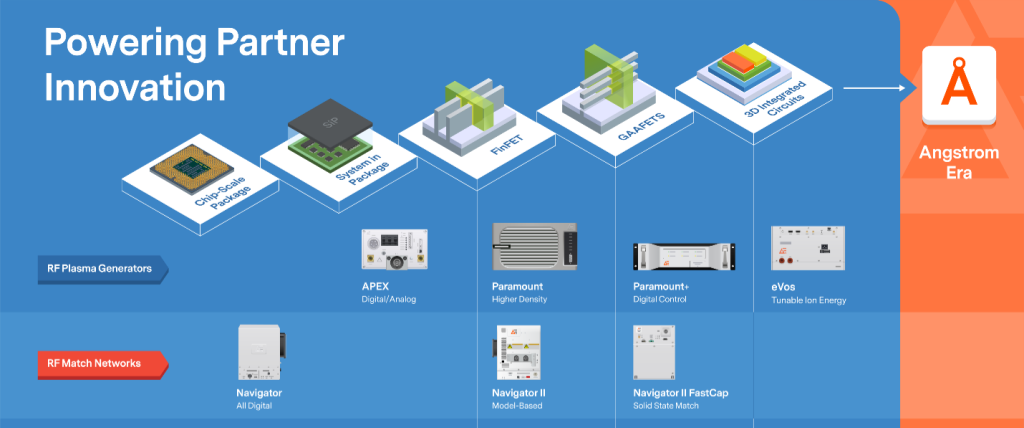
As the semiconductor industry advances toward angstrom-level scaling, the need for ultra-precise, contamination-free processing is sharper than ever. Plasma-based technologies are now essential to achieving atomic-level material control, offering the selectivity, uniformity and tunability required for next-generation devices. Erik Hosler, an expert in semiconductor innovation, recognizes how plasma systems are enabling the fabrication of high-aspect-ratio features and delicate interfaces, especially where conventional wet or thermal methods fall short.
Plasma is a partially ionized gas composed of ions, electrons and neutral species. In semiconductor fabrication, it plays a critical role in etching, thin film deposition and surface treatment. Its ability to control ion energy, directionality and chemical reactivity makes it a key enabler for modern transistor scaling, 3D NAND structures and advanced packaging.
Precision at the Atomic Scale
Achieving sub-nanometer accuracy in pattern transfer and material modification requires techniques that go beyond traditional approaches. Plasma etching allows for directional ion bombardment, enabling anisotropic profiles essential for forming narrow vias and trenches with vertical sidewalls.
In atomic layer etching, plasma pulses are used to remove one atomic layer at a time through a cyclic process of surface modification and low-energy ion exposure. This method allows for the controlled thinning of films without damaging underlying structures, a critical capability as device layers become thinner and more fragile.
Similarly, plasma-enhanced atomic layer deposition uses plasma to activate precursors and improve film conformality on complex topographies. This is especially important for depositing high-k dielectrics or metal gates in advanced logic nodes.
These atomic-scale processes require an intricate balance of ion density, energy and species composition. Engineers must tune plasma chemistry and chamber conditions to prevent defects such as roughness, line edge distortion or residue accumulation.
The sensitivity of modern structures makes uniformity and repeatability across wafers essential. Erik Hosler explains, “Tools like high harmonic generation and free electron lasers will be at the forefront of ensuring that we can meet these challenges.” These advanced diagnostics are critical for validating plasma processes at the atomic scale and keeping them within tightly controlled performance thresholds.
Tailored Chemistries for Selective Processing
One of plasma processing’s strengths is its chemical flexibility. By adjusting gas mixtures, pressure and power, plasma systems can be tuned to selectively target one material while leaving adjacent layers untouched.
This selectivity is vital in multi-material stacks where interfaces must remain intact during etching or deposition. For example, in gate-all-around FETs, selective etching of silicon germanium from nanosheet channels requires precise control to avoid damage to silicon layers.
Fluorocarbon plasmas are commonly used for etching silicon-based materials, while halogen-rich chemistries enable fine-tuned control over metals and high-k dielectrics. Oxygen plasmas serve as gentle cleaning agents for organic contamination, and hydrogen plasmas help passivate dangling bonds.
Beyond etching, plasma treatment can modify surface energy, enhance adhesion or reduce interface states, all of which contribute to improved device performance and reliability. These treatments are often used prior to dielectric deposition or metallization steps.
Advanced patterning schemes, such as spacer-defined double patterning and self-aligned patterning, also rely heavily on plasma etch processes to achieve line edge control and maintain CD uniformity. These techniques are indispensable at nodes below 5 nanometers, where lithographic resolution is limited.
Challenges in 3D Structures and Packaging
The shift to 3D integration introduces new demands on plasma processing. High aspect ratio features such as deep vias, trenches, and holes used in NAND, DRAM and through silicon vias require highly directional etching with minimal microloading and profile distortion.
Aspect ratios exceeding 40 to 1 are now common, and any deviation in plasma uniformity can result in incomplete etching or profile collapse. To address this, plasma tools must deliver stable plasma densities and uniform ion flux across the wafer.
Etching in confined spaces also increases the risk of polymer buildup and plasma-induced charging, which can damage gate oxides or introduce yield-limiting defects. Careful control of sidewall passivation and ion energies is required to mitigate these effects.
In advanced packaging, plasma treatments activate the surface prior to wafer bonding or redistribution layer formation. These steps ensure strong mechanical and electrical interfaces between stacked dies or chiplets. Plasma-based processes also support under-bump metallization and low-temperature soldering, enabling high-density interconnects in heterogeneous systems.
Sustainable and Low-Damage Alternatives
While plasma processing offers precision, it can be unpleasant if not carefully managed. Ion bombardment and UV radiation may damage sensitive layers or generate particles that compromise yield. To address these risks, manufacturers are turning to gentler plasma modes such as remote plasma, pulsed plasma and microwave plasma. These approaches reduce direct ion contact with the wafer and offer better control over reaction pathways.
Remote plasma systems are used for low-temperature oxide and nitride deposition, ideal for applications in flexible electronics and back-end integration. Pulsed plasmas allow separation of ion and radical exposure, useful for minimizing substrate damage during atomic layer etching.
Process engineers are also exploring plasma chemistries that reduce greenhouse gas emissions. Traditional etchants like perfluorinated compounds have high global warming potential. Replacing these with alternative chemistries and improving abatement systems aligns plasma processing with sustainability goals. In addition, innovations in chamber design and endpoint detection help minimize overprocessing, reducing power use and gas consumption.
Future Directions and Industry Impact
Plasma-based semiconductor processing is poised to grow in complexity as devices become more heterogeneous and vertically integrated. The need to control material properties with atomic fidelity will make plasma systems even more central to next-generation fabrication.
Toolmakers are advancing real-time plasma diagnostics, closed-loop process control and multi-zone reactors to meet the growing demand for precision and flexibility. New applications in quantum computing, MEMS and photonics will require even more tailored plasma environments.
Integration with AI-driven process tuning may further enhance reproducibility and shorten development cycles, supporting faster deployment of new device architectures. As innovation in materials continues, plasma systems must adapt to handle novel substrates, interfaces and geometries. This adaptability is what makes plasma processing not only a necessity but also a long-term enabler of semiconductor advancement.
Where Precision Meets Process Intelligence
Plasma-based semiconductor processing has become one of the most indispensable tools in modern chip manufacturing. It provides the control and customization needed to build atomic-scale features, treat delicate surfaces and navigate complex material stacks. By refining plasma parameters at the microscopic level, engineers are shaping devices that operate faster, consume less power and scale into new applications.
In an industry defined by precision, plasma stands out as the medium where control meets creativity. As technologies continue to shrink and diversify, plasma will remain central to solving the challenges of tomorrow’s fabrication. It is no longer just a tool for etching and deposition; it is a platform for atomic-scale design.
