

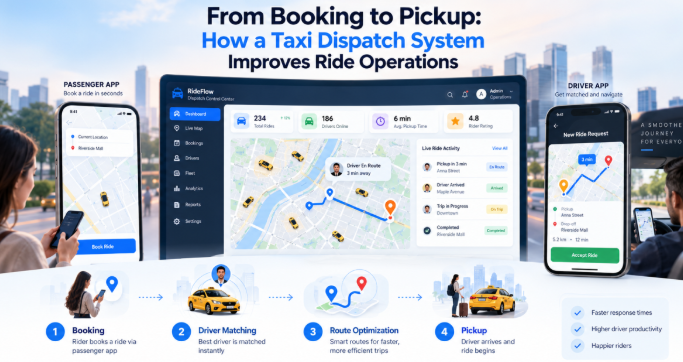
Every taxi ride requires an app for booking and payment after completion. What changes in different software is the operation handling in between the ride. It decides whether the ride feels smooth or frustrating. A capable taxi dispatch system manages that entire sequence, start to finish.
Most people think of dispatch as simply assigning a driver to a rider. In practice, it touches nearly everything. How the booking gets confirmed, how the right driver gets matched. How routing adjusts in real time, and how the pickup itself gets handled.
This piece walks through that full journey, stage by stage. Along the way, it looks at what makes a taxi dispatch solution work well. From one that just barely functions. And why each stage matters more than it first appears.
The Booking Stage: Where the Ride Begins
Everything starts with a single tap, but a lot happens behind that tap instantly. The app needs to confirm the pickup location and check availability. It also estimates a fare, all within seconds.
Good online taxi booking software makes this step feel instant to the rider. Even though several checks run in the background. Location accuracy, driver availability, and pricing logic all have to align first.
What Happens the Moment a Rider Taps Book
A few things happen almost simultaneously once a booking request goes out:
- The taxi dispatch system checks GPS coordinates to confirm an accurate pickup point.
- Nearby driver availability gets scanned within a defined radius.
- A fare estimate is calculated based on distance, time, and current demand.
- The booking gets logged, timestamped, and queued for driver matching.
None of these steps happen in isolation. They run together, in parallel. That’s why reliable booking is harder to build than it looks.
Common Booking Failures Without Smart Systems
Not every platform gets this right. Weak systems tend to fail in predictable ways:
- Fare estimates swing wildly between booking and pickup. Riders notice fast.
- Driver assignment can drag on for minutes. Poor taxi dispatch software is usually why.
- Some bookings fail without warning during demand surges, with no error shown.
- Pickup pins land in the wrong spot, especially near dense complexes.
Each failure traces back to one root cause. The booking stage wasn’t built for real-world conditions, only ideal ones.
The Matching Stage: Assigning the Right Driver
Once a booking is confirmed, the system decides who gets the ride. This sounds simple. In practice, it’s one of the most complex parts of the entire process.
A good taxi dispatch system doesn’t just grab the closest available car. It weighs several factors at once, balancing speed and fairness. Efficiency across the whole fleet matters too.
How Matching Logic Actually Works
Matching typically considers a combination of signals:
- Proximity: Actual road distance counts, not straight-line distance on a map.
- Driver direction: A car already heading toward the pickup gets priority.
- Vehicle type: Sedan requests go to sedans, SUV requests go to SUVs.
- Driver history: Unreliable drivers rarely get paired with high-value trips.
- Traffic conditions: The nearest car isn’t always the fastest one.
A capable taxi cab dispatch software engine handles this in under a second. Every single time a booking comes in. Riders never see this complexity. They just see a driver’s name and an estimated arrival time. It appears almost instantly on their screen.
What Riders Never See Happening
A few things happen behind every match, invisible to the rider on the curb:
- The system re-checks driver availability right before confirming, just in case something changed.
- A declined or timed-out first choice triggers an automatic backup match.
- Fleet-wide load balancing keeps too many idle cars from bunching in one zone.
This backend complexity explains why some platforms feel effortless. Others feel clunky, even though riders can’t say why.
The Routing Stage: Getting the Driver There Efficiently
Once a match happens, the driver still has to get there. This stage seems purely mechanical, just point A to point B. It’s actually where much of the ride quality is decided.
A basic system sends one static route and hopes for the best. A stronger taxi dispatch solution adjusts that route continuously. It reacts to traffic, road closures, and changing weather conditions. All of it happens in real time, continuously.
Real-Time Navigation and Traffic Adjustments
Real-time routing typically includes:
- Live traffic data pulled from multiple sources, not a single static map.
- Automatic rerouting the moment a road closes or a jam forms ahead.
- ETA updates that adjust continuously, instead of showing one fixed number.
- Historical pattern awareness, learning which roads slow down at specific times daily.
Without this layer, a driver might follow an outdated route. One that looked fine ten minutes ago. Now it might be a parking lot instead. Riders feel this directly, through ETAs that keep sliding backward. Instead of counting down reliably, as they should. A dependable taxi dispatch system keeps that number honest throughout the trip.
The Pickup Stage: Where Experience Is Won or Lost
The final few minutes before a ride starts matter more than most operators realize. This is where riders form their strongest impressions, good or bad.
A confusing pickup experience can undo everything that worked well earlier in the journey. Standing on the wrong corner, unsure which car is theirs, hurts everything. It erases the value of a fast booking and a smart match.
Reducing Pickup Confusion and Wait Anxiety
An online taxi management system helps solve this in a few concrete ways:
- Precise pickup pins that account for building entrances, not just rough coordinates.
- Live driver tracking so riders can watch the car approach in real time.
- Vehicle and driver details shared clearly, including plate number and photo.
- Two-way communication built into the app, for coordinating exact meeting points.
- Automatic notifications when the driver arrives or is running a few minutes late.
None of these features are complicated individually. Together, they remove nearly all the uncertainty around pickup. For many riders, that’s the most stressful part of a ride.
What Happens Behind the Scenes Throughout
While a rider experiences four simple stages, operators see something bigger. Every booking, match, and pickup feeds into a live operational view.
A complete taxi booking and dispatch software platform gives operators full fleet visibility. Not just individual trips happening one at a time. When combined with fleet management software, operators can monitor vehicle locations, driver activity, fleet performance, and overall operations from a centralized system.
This behind-the-scenes layer typically includes:
- Live fleet maps: Every vehicle’s location and status shows up at a glance.
- Performance dashboards: Driver ratings, trip counts, and response times, all tracked here.
- Demand heat maps: They highlight exactly where bookings are spiking right now.
- Automated reporting: Daily, weekly, and monthly trends, summarized without manual work.
- Exception alerts: Cancelled trips, long waits, or driver issues get flagged instantly.
None of this is visible to riders, and it shouldn’t be. It exists so operators can catch problems early. It also helps them adjust fleet positioning proactively. That keeps every earlier stage running smoothly.
Why Each Stage Needs to Work Together
It’s tempting to think about these four stages separately. Booking, matching, routing, and pickup as isolated problems. In reality, weakness in one stage drags down the others.
A fast booking means little if matching takes too long. Great matching means little if routing sends the driver the wrong way. Smooth routing means little if the pickup point is confusing.
This is why a single, integrated taxi dispatch system consistently wins out. It outperforms a patchwork of separate tools stitched together later. When one company builds and owns the entire flow, data moves freely between stages. A delay in matching can trigger a routing adjustment automatically. A pickup issue can feed back into how future bookings get handled.
Fragmented systems can’t do this. Each piece operates in its own silo, blind to the rest.
Choosing the Right System for This Entire Journey
For fleet operators evaluating options, one temptation stands out. Focus on one visible feature, like a clean booking screen. Or a nice-looking map. That’s a mistake.
The stronger question is whether a provider handles the entire journey well. From the first tap to the final pickup. A genuinely capable taxi dispatch software provider speaks confidently about every stage. Not just the one stage that demos best.
Questions Worth Asking Any Provider
A few questions separate serious providers from ones offering surface-level polish:
- How does the system handle booking failures during high-demand surges?
- What signals does the matching engine actually weigh, beyond simple proximity?
- Does routing update in real time, or rely on a single static path?
- How is the pickup experience designed, beyond a car icon on a map?
- What operational visibility does the dispatcher dashboard actually provide?
A vague or evasive answer to any of these usually signals a gap. A confident, specific answer usually signals the opposite. Especially when it’s backed by a working taxi cab dispatch software demo.
Every Stage Deserves the Same Attention
The distance between booking and pickup looks short on a map. Operationally, it’s actually four distinct challenges stacked on top of each other. Booking has to be fast and accurate. Matching has to be smart and fair. Routing has to adapt in real time. Pickup has to feel clear and reassuring.
A well-built taxi dispatch system treats all four as equally important. Not just the parts that show up in a demo video. Operators who understand this invest evenly across the whole journey. Rather than polishing one stage while neglecting the rest.
Riders rarely think about any of this consciously. They just noticed whether the ride felt easy or difficult. That feeling, more than any single feature, is what matters. It’s what a genuinely well-built platform delivers, ride after ride.
