

Key Takeaways
- Bay-front trees in Calvert County need selective pruning that improves structure without stripping away too much healthy canopy.
- Empire Tree Services helps homeowners identify deadwood, weak branch unions, long end-heavy limbs, clearance problems, and storm-related hazards.
- Pruning can reduce certain risks, but it cannot make a tree completely storm-proof when extreme wind, saturated soil, decay, or root failure are involved.
- Coastal properties may also need to consider Chesapeake Bay Critical Area requirements before authorizing extensive vegetation work.
- When a tree has severe decay, major cracks, root movement, or extensive storm damage, removal may be safer than continued pruning.
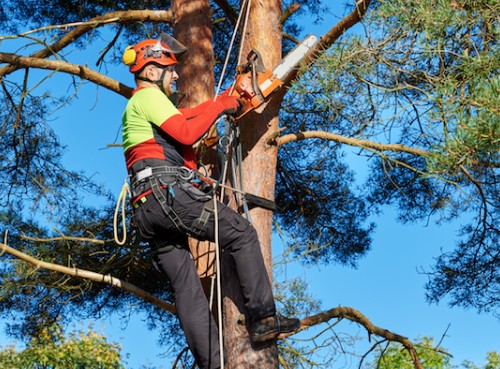
For Calvert County homeowners, thoughtful pruning is one of the best ways to prepare healthy trees for the repeated wind exposure that comes with life near the Chesapeake Bay, the Patuxent River, creeks, and open shoreline. Empire Tree Services provides professional tree pruning in Calvert County, MD for property owners who need a careful plan for hazardous limbs, overextended branches, roof clearance, and better tree structure before the next period of severe weather.
Rather than treating every tree as a candidate for heavy cutting, Empire Tree Services focuses on the condition of the individual tree and the conditions around it. A mature oak near a waterfront deck, a tall tulip poplar beside a driveway, a pine exposed above a sloping yard, and a maple growing close to a home all present different concerns. The goal is not to remove every branch that moves in the wind. The goal is to identify defects that can be reasonably addressed while preserving the tree’s health, balance, and long-term value.
Why Bay-Front Wind Creates Special Challenges for Calvert County Trees
Wind behaves differently on a protected, wooded lot than it does on a property with open exposure to the Bay. Trees near Chesapeake Beach, North Beach, Lusby, Solomons, Port Republic, Broomes Island, Huntingtown, and other coastal areas may receive repeated gusts with fewer nearby trees or buildings to soften the force. An isolated tree can experience more direct pressure across its canopy, particularly when it has long horizontal limbs or a broad, uneven crown.
Soil conditions matter as much as the canopy. Heavy rain can saturate soil and reduce the holding strength around roots, while erosion, shoreline changes, grading, trenching, and compacted soil can further affect stability. Empire Tree Services looks beyond the visible branches when evaluating a wind-exposed tree. A canopy may appear full and healthy while the trunk, root flare, or soil around the base shows signs that deserve closer attention.
Common warning signs include dead or hanging limbs, branches rubbing against each other, narrow branch angles with included bark, multiple competing leaders, visible cracks, fungal growth, cavities, and a lean that appears new or has changed. These conditions do not always mean a tree must come down, but they do mean it should not be ignored before a strong coastal storm.
How Empire Tree Services Approaches Wind-Resistance Pruning
Empire Tree Services begins with the whole property, not just the branch the homeowner can see from the ground. The crew considers where the tree stands in relation to the water, open fields, slopes, homes, fences, garages, vehicles, docks, walkways, and nearby utility corridors. This site-focused approach helps determine both the likelihood of a failure and what could be damaged if one occurs.
Next comes a closer review of tree structure. Empire Tree Services assesses major limbs, branch unions, trunk condition, leaders, visible root-zone concerns, deadwood, and the amount of weight carried at the ends of long limbs. That distinction matters because a tree does not become safer simply because it has fewer branches. Proper pruning is purposeful. It removes or reduces specific concerns while retaining enough healthy foliage for the tree to produce energy and respond well after the work is complete.
Deadwood Removal for Safer Outdoor Areas
Dead branches are among the clearest pruning priorities, especially above roofs, driveways, patios, decks, outdoor seating areas, play spaces, and access lanes. They no longer contribute to the tree’s health and can fall during ordinary gusts, not only during major storms. Removing elevated deadwood often requires professional equipment, safe access planning, and controlled lowering techniques when there are structures beneath the work area.
Empire Tree Services can remove these hazards while keeping the job organized around property protection and cleanup. This is particularly valuable on wooded coastal lots, where a broken limb may be suspended high in the canopy and difficult to judge safely from below.
Reducing Long, End-Heavy Limbs
Long branches extending toward a house or across a driveway can carry substantial leverage in strong wind. Selective reduction pruning can shorten an overextended limb back to an appropriate lateral branch, helping shift weight closer to a stronger point of support. Empire Tree Services uses this type of pruning to address specific structural concerns without resorting to indiscriminate cutting.
This is not the same as chopping branch ends off at random. Poor cuts may leave stubs, encourage weak regrowth, or create wounds that do not close well. A well-planned reduction considers branch size, growth direction, the remaining canopy, and the tree’s natural form.
Addressing Weak Unions and Competing Leaders
Some trees develop stems that grow close together with a narrow attachment angle and included bark between them. These unions can be weaker than a broad, well-connected branch union, especially as the stems become larger and heavier. In younger trees, selective corrective pruning can often guide better structure before the defect becomes more serious.
For mature trees, Empire Tree Services evaluates whether limited reduction, monitoring, cabling recommendations from an appropriate specialist, or removal is the more sensible path. The right answer depends on the extent of the defect, the health of the tree, its exposure to wind, and the targets below it. A large weak leader leaning over a home deserves a different response than a similar leader over a lightly used wooded area.
Why Topping and Excessive Thinning Are Not the Answer
Homeowners sometimes assume that taking away a large share of the canopy will automatically make a tree safer in wind. In reality, topping can leave large wounds, remove the tree’s natural structure, and trigger fast-growing shoots that are often weakly attached. Excessive thinning can also create more wind exposure inside the canopy and leave branches poorly balanced.
Research on structural pruning and tree movement in high winds supports the value of deliberate, targeted pruning rather than routine over-cutting. Empire Tree Services applies that practical principle by concentrating on deadwood, hazardous defects, end weight, crossing branches, and clearance conflicts. A coastal tree needs sound structure, not a bare crown.
When Should Calvert County Homeowners Schedule Pruning?
Late fall through winter is often a useful window for routine pruning because many deciduous trees have dropped their leaves, making branch structure easier to inspect. Dormant-season work can also be a convenient time to correct crossing limbs, evaluate leaders, and remove deadwood before spring growth begins. However, the best timing still depends on the tree species, the scope of work, and the reason for pruning.
Safety-related pruning should not wait for a preferred season when a dead, broken, cracked, or hanging limb threatens people or property. Empire Tree Services also provides emergency tree removal and storm cleanup when a storm-damaged tree blocks access, damages a structure, or creates an immediate hazard. Homeowners should avoid climbing ladders, using chainsaws overhead, or attempting to pull down lodged branches after a storm.
Critical Area Questions for Waterfront and Near-Water Properties
Many Calvert County waterfront and near-water lots fall within areas where vegetation work may require special review. Before authorizing significant cutting, homeowners should review whether their property is subject to vegetation removal requirements in the Critical Area. The answer can depend on the property location, the type of vegetation involved, the planned work, and whether the situation is an emergency.
Empire Tree Services can help homeowners understand the practical scope of needed tree work and can discuss permitting assistance for qualifying projects. It remains important for the property owner to confirm applicable requirements before removal, clearing, or work that affects shoreline buffers, steep slopes, drainage areas, or protected vegetation. Pruning for a genuine safety concern may be different from broad clearing or removal, so each project should be evaluated on its own facts.
When Pruning Is Not Enough
Pruning is a valuable tool, but it should not be used to disguise a tree that has become an unacceptable hazard. Empire Tree Services may recommend removal when a tree has extensive trunk decay, major cracks through structural wood, a severely compromised root zone, substantial root plate lifting, multiple large dead leaders, or storm damage that leaves the tree unstable.
Because Empire Tree Services offers tree removal, emergency response, stump grinding, storm debris cleanup, land clearing, forestry mulching, and commercial tree services, homeowners do not need to force every situation into a pruning-only solution. The crew can develop a practical scope that matches the condition of the tree and the future plans for the property. If removal is necessary, stump grinding can also help prepare the area for lawn restoration, landscaping, access improvements, or replacement planting.
What Homeowners Should Watch for Before Calling Empire Tree Services
- Dead limbs over high-use areas:Branches above roofs, driveways, decks, docks, and walkways deserve prompt attention.
- Fresh cracks or splits:A new opening near a trunk or major branch union can signal a structural problem.
- Rubbing branches:Repeated movement can create bark wounds and weak points over time.
- Sudden leaning or lifted soil:New movement at the base of a tree can indicate root failure.
- Construction near roots:Recent excavation, driveway work, utility trenching, or grading can affect stability.
- Limbs contacting structures:Roof contact, siding abrasion, blocked driveways, and interference with service lines can worsen during storms.
Why Empire Tree Services Is a Practical Choice for Coastal Tree Care
Empire Tree Services serves Calvert County and Southern Maryland with a combination of routine tree care and storm-response services. The company emphasizes on-site assessments, transparent estimates, professional equipment, property-conscious work practices, cleanup, and follow-up support. Its service range is especially useful for coastal homeowners who may begin with a pruning concern but discover that a removal, stump service, or post-storm cleanup plan is also needed.
For trees exposed to Bay-front wind, the most useful service is not a generic trim. It is a clear assessment of structure, exposure, defects, access, and nearby targets. Empire Tree Services helps property owners make that decision with a focus on practical risk reduction and the health of the landscape. Healthy coastal trees do not need to be stripped bare to face wind. They need timely inspection, selective pruning, and experienced care when conditions call for more extensive action.
Contact Empire Tree Services
Calvert County homeowners concerned about hazardous limbs, long overextended branches, storm preparation, or damaged trees can contact Empire Tree Services to request an on-site assessment. A professional evaluation can help determine whether selective pruning, monitoring, emergency work, or removal is the safest next step for the property.
Location: Empire Tree Services | 29816 Adams Rd, Mechanicsville, MD 20659, United States | (240) 585-1152 | https://localtreeman.com/
