

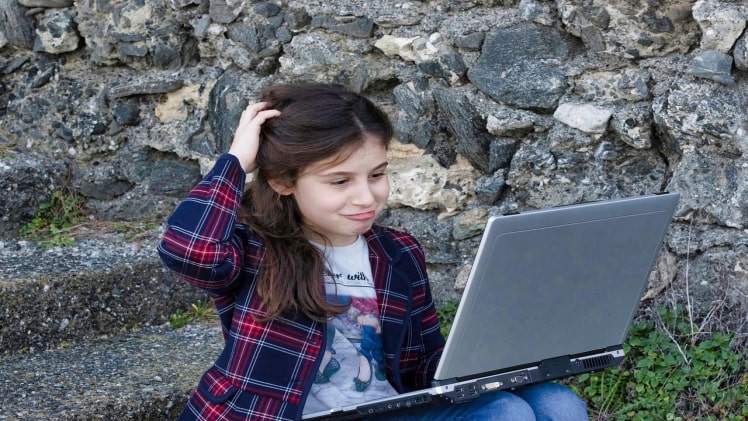
To what extent does the Internet help or hinder the health and success of children? Are children who use the Internet a lot under more stress and why are such children sadder? How does the Internet affect children’s mental health and does the Internet reduce success in school?
In the modern world today, there’s almost no person who isn’t online at least once a day. Of course, most of us are online many times a day, and analyzes show that we spend several hours of our lives online every day (excluding business commitments).
The trend of increased use of the Internet is more and more present among children, unfortunately, there are more and more small children who are exploring the magic of the Internet. Some older generations remember growing up outdoors, at playgrounds, well while younger generations replaced it all with the Internet. New research shows how this negatively affects children, who have growing mental problems due to excessive Internet use.
Excessive Use of the Internet by Children
According to statistics, as many as 95% of children aged 3 to 18 in developed countries have had contact with the Internet at least once in their lifetime. Of course, most of these children have contact with the Internet every day and maybe only a few hours pass without these children peeking into the Internet. Although the Internet is the foundation of society and the economy today, the fact is that children spend far too much time online. Gone are the offline activities in which children develop their motor and social skills, and fun and play are reduced exclusively to a virtual world.
Unfortunately, it’s said that children generally follow the example of their parents who are online all the time, using the Internet for work, fun, socializing with people, playing video games, gambling online at online casinos in Israel, communicating, and traveling. If we want to raise some “normal” new generations of children, it’s time to think carefully about the extent to which children need the Internet. Namely, most of the time that children spend online is focused on playing and having fun with others. But it would be much more efficient and better if they spent the time spent on the Internet in real physical socializing with other children. There’s an interesting paradox where parents overprotect children in the physical world, and at the same time don’t protect them at all from the virtual online world.
Year after year, we’re witnessing more and more children and young people ending up in various video games and Internet addiction clinics. Unfortunately, there are a lot of parents who don’t even recognize this problem in their children and let their children do what they want, and that’s not good at all. Sitting at the computer for three or more hours isn’t good for children’s health, especially for children who are still developing. The data show that children spend far too much time on computers, smartphones, and tablets, but the problem isn’t solved. It seems we haven’t yet adapted to modern times where we need to learn how to live with and without the Internet and technology.
Research Shows That the Internet Affects Children’s Mental Health
A study conducted in Korea a few years ago has finally announced its results, which, unfortunately, aren’t good at all. Namely, it has been established that excessive use of the Internet affects the mental health of children by creating stress, fear, sadness, and even suicidal thoughts. On the other hand, children who don’t use the Internet are healthier, more capable, and perform better in school.
The 2018 survey was conducted in Korea on a sample of nearly 30,000 high school students. It should be emphasized that 30,000 participants are a very representative sample for obtaining quality research results. The aim of the research was to determine how much the use of the Internet has an impact on other segments of teenagers’ lives, i.e. how the Internet changes their perception of life, health, but also life skills. The research was conducted by Seoul’s Chung-Ang University, and the results published recently are quite worrying.
The results of the research established the fact that excessive use of the Internet is certainly not suitable for many basic aspects of life. Not only does excessive Internet use impair the quality of daily activities, but it also leaves a long-term impact on high school students and children. Namely, research has shown that children who spend a lot of time on the Internet perform worse in school, which definitely leaves a mark on the future lives of children. With poorer school performance, children who overuse the Internet are under more stress and feel sadness much more intensely. Unfortunately, for many children, this also leads to suicidal thoughts. Thus, excessive Internet use among children seems to have a significant negative impact on children’s mental health.
Children of Lower Economic Status Use the Internet More
The research also led to a precisely defined number of minutes that children aged 16 to 18 spend online (in their free time). School-age children spend as much as 193.4 minutes a day on the Internet, which is more than three hours a day. Imagine how many different physical activities, socializing, and wonderful moments these children could have if they spent time in nature instead of online. The question is: How do children spend those 193 and so minutes online? Do they spend that time playing video games, talking to friends, watching funny videos, or something else? Do you often wonder how your children spend time online?
The research showed one interesting connection: Children of lower economic status (poorer children) spend more time online. We can link many things to this fact – from the fact that poorer children can’t get so many extracurricular activities, to the fact that such children seek acceptance and society for themselves online, to the thesis that such children simply don’t see enough space to succeed in life so the spend time on the Internet related entertainment. What the exact reason for this is, it’s hard to conclude, but it definitely seems like we have a clear link between more minutes online and less money in our wallets.
The main problem in this whole story is certainly the fact that excessive use of the Internet affects the mental health of children. The research concluded that children who overuse the Internet are under much more stress and that they feel sadness much more often and more intensely. At the same time, such children subjectively feel less healthy and physically less prepared and achieve poorer school performance. All this, step by step, leads to suicidal thoughts, but also to the big question: How to proceed in the future. It’s a bit amazing what all the links and negative sides of life can open up with the question of excessive Internet use.
The Solution to the Problem Is to Turn To Real Life and Physical Socializing
The first step in solving this big global problem is definitely to realize that the problem of addiction to the Internet and video games exists. This isn’t some imaginary and non-existent addiction, but a real problem that requires an urgent and quality solution. Fortunately, as they grow older, many people stop having time to play video games for a long time and endlessly surf social networks so this addiction slowly subsides on its own. But if you’ve noticed that one of your close friends or family members is constantly spending time on your computer or smartphone without some valid reason for it, it’s probably a kind of Internet addiction.
Many parents tackle the problem of excessive Internet use by shouting at their children and placing various bans on the use of the Internet and video games. But solving the problem this way is unlikely to be overly effective. Namely, children are driven by their parents’ behavior and won’t accept the fact that parents can type on the phone all day, while children can’t. Therefore, parents need to become an example of how to behave responsibly online and how to consume online content wisely and meaningfully. The Internet has been reduced to sensationalism, where various dramatic revelations pop up every day, making us sad and depressed. Therefore, sometimes it’s better to ‘disconnect’ from the Internet and enjoy the real world, which is wonderful.
Be a positive example to your children and encourage them to do something together with you instead of bans. Offer to go for a walk with them, to build an object or item, to do something fun in relaxing nature. Simply, become an example of how the world around us offers much more fun and useful content than typing on a smartphone or computer.
The Internet is conceived as an assistant in our lives, not as the center of our lives. We need to act accordingly and always look at information from the Internet as an extra step, not as the core of our lives. If you’re already heavily dependent on computers and the Internet at school or at work, at least then spend your free time exploring the real world around you. Go for a walk, have coffee with family or friends, and do something positive for your physical and mental health. And not just for yourself, but involve other members of your family as well because real socializing with loved ones is invaluable. If not sooner, you’ll realize this at the end of your life. But then it’s too late. Therefore, seize every moment and move away from the Internet world.
