

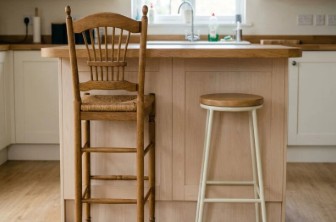
The backless stool won the design argument two decades ago and has been quietly losing the operational one ever since. It looks cleaner, it tucks fully under a counter, it costs less, and it appears in almost every photograph of a bar built since 2010. None of those is a reason to put one in a room where people are expected to stay for two hours.
The honest comparison is not that one type is better. Bar stools with and without backs solve different problems, and the mistake almost every room makes is choosing one type for the entire run rather than deciding position by position.
What the Back Actually Does
Start with the mechanism, because the argument is usually conducted on appearance.
Sitting is a loaded position rather than a rest position. Weight that the legs and feet carried while standing concentrates onto a small area of the pelvis, and the lumbar region loses the support an upright posture gave it.
A back does not make the seat softer. It adds a second posture. The guest can lean, which shifts load off the pelvis and onto the spine, then sit forward again, and that alternation is what extends comfortable duration. A backless stool permits one position and the only available change is standing up.
Where Backless Is Genuinely Correct
There are rooms where the backless stool is the right answer and it is worth being specific about them.
High-turnover counters. Somewhere people sit for twenty minutes, eat and go. The back is not doing anything in that window and the stool tucks fully away when the position is empty, which matters in a narrow room.
Tight circulation. A backless stool has a smaller occupied footprint, and in a space where the aisle behind the counter run is marginal that difference is the whole layout.
Rooms with sightline constraints. Anywhere the view across the room matters, a backless run keeps it open in a way nothing else does.
Where Backed Is Not Optional
The opposite cases are just as clear and get ignored far more often.
Any position expected to hold somebody past an hour. Bars where people eat full meals, cafes with an afternoon working crowd, hotel bars where the whole business model is people staying.
Any position an older guest is likely to choose.
A back gives something to push against when standing, and its absence turns rising from a thirty-inch seat into a small public production.
Guidance on seated work from OSHA is written for offices and the underlying finding transfers directly: sustained sitting requires postural variety more than it requires cushioning. A backless stool structurally cannot provide it.
The Argument Against Mixing, and Why It Is Wrong
The standard objection to running both is that a mixed run looks untidy.
In practice the opposite is true in photographs. A row of eight identical stools reads as a fence: identical verticals at identical spacing, with nothing for the eye to organize around. Introducing backs on a proportion of the run breaks that repetition and gives a wide shot a subject.
It also gives guests a choice they will exercise. Rooms that mix report that the backed positions fill first and stay occupied longest, which is a useful piece of information about what the room’s guests actually want.
That pattern is worth watching rather than assuming. A bar where the backless positions fill first is telling its owner something genuine about how the room is used, and it is the kind of evidence that never appears in a survey.
The Proportion That Works
Most rooms that have run both converge on a similar split.
Backs on roughly a third to a half of the run, concentrated away from the service well and toward the end of the bar with the best view of the room. Those are the positions people choose when they intend to stay, so they are the positions where the back earns its cost.
Backless in the middle of the run, where turnover is highest, where staff pass most often, and where a fully tucking stool keeps the circulation clear.
The Accessible Position Is Neither
There is a third category that gets forgotten in this argument entirely.
Under the 2010 ADA Standards, bar counters are dining surfaces and a proportion must be accessible with compliant knee and toe clearance, dispersed rather than clustered. That position has no stool at all, backed or otherwise.
Which means the stool debate applies to the rest of the run, and the accessible section has to be planned first rather than fitted into whatever is left. A room that decides its stool mix before deciding where the accessible position sits will put it beside the service well, which is where it always ends up.
How to Decide Position by Position
For an operator specifying a bar run rather than buying a single product:
- Estimate expected dwell for each third of the run, not for the bar as a whole
- Put backs where people intend to stay, away from the service well
- Keep backless where turnover is highest and circulation is tightest
- Check the occupied footprint of the backed option against the aisle behind it
- Place the accessible section first, at an end with a view of the room
- Sit in both versions for ninety minutes before committing to a proportion
The Decision the Photograph Made For You
The reason so many bars are entirely backless is not that anybody compared the two. It is that the backless stool is what appears in the reference images, and reference images are taken in empty rooms where nobody is testing the second hour.
A backless run photographs as clean and behaves as a time limit. A mixed run photographs better than most operators expect and holds people considerably longer, which is the only outcome the bar is actually being paid for.
The choice was never between two products. It was between deciding the mix deliberately and letting a catalog photograph decide it, and most rooms have quietly taken the second option.
