

Key Takeaways
- Define the coin’s purpose before selecting artwork or finishes.
- Use two or three meaningful symbols rather than filling every available space.
- Keep lettering brief, accurate, and readable at the coin’s actual size.
- Match the shape, finish, and optional features to the occasion.
- Review the final proof carefully before approving production.
- Give the coin meaning through a thoughtful presentation.
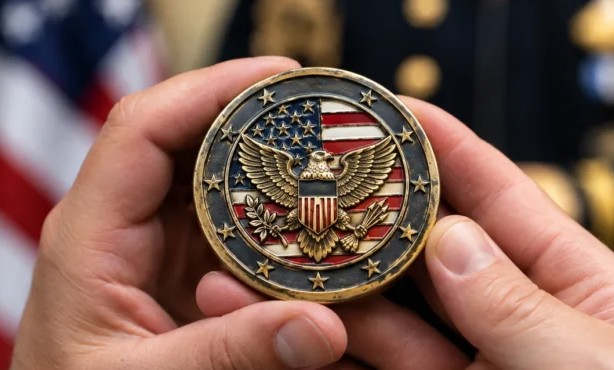
A meaningful challenge coin starts with a story people recognize. In Texas, that story may be connected to a volunteer fire department, a school tradition, a Gulf Coast recovery effort, a West Texas work crew, a military retirement, or a nonprofit serving its neighborhood. Whether you are planning challenge coins made in Texas for a formal presentation or a close-knit team, the design should reflect the people and purpose behind it.
The best coins do not try to say everything at once. They use a clear purpose, a few memorable symbols, and wording that remains easy to read at a small size. A well-considered coin can become a lasting reminder of service, belonging, achievement, or a shared moment.
Why Meaning Matters More Than Decoration
Challenge coins are often exchanged to recognize membership, service, teamwork, milestones, or a shared experience. Their military associations are part of a broader tradition, although the exact origin story is not settled. The history of challenge coins includes several competing accounts, which is a useful reminder that the meaning of a modern coin comes from the people who give and receive it.
A Texas-themed coin does not need a longhorn, state outline, flag, bluebonnets, oil derrick, and star all at once. One local symbol can be stronger when it connects directly to the group. A river bend may represent a community cleanup project. A lighthouse may fit a coastal unit. A mesquite silhouette or mountain horizon may feel right for a team based in West Texas.
Step 1: Define the Coin’s Purpose
Before discussing color, metal tone, or special effects, write the purpose in one sentence. For example: “This coin recognizes volunteers who completed a year-long neighborhood restoration project.” That sentence becomes the test for every design choice.
- Recognition for service or leadership
- Retirement, promotion, or career milestones
- Team membership and unit identity
- Training or program completion
- Commemoration of an event, reunion, or anniversary
- Community response and public safety achievements
Step 2: Identify the Intended Recipients
Recipients should guide the design. A coin for a San Antonio youth mentoring program may feel warm and community-centered, while one for a Panhandle emergency response team may call for a more formal and durable visual style.
Questions to Ask Before Designing
- Who will receive the coin?
- What achievement, place, or event does it recognize?
- What should recipients remember years from now?
- Should the tone feel historic, official, personal, bold, or lighthearted?
- Is this a one-time presentation or the beginning of an annual tradition?
Step 3: Turn the Story Into Strong Symbols
Reduce the story to two or three visual ideas. A bridge can represent cooperation. A compass can suggest direction and service. A local landmark can connect the coin to a particular Texas community. Select symbols that recipients will understand without requiring a lengthy explanation.
Avoid adding images only because there is open space. Instead, remove anything that does not support the main message. Showing an early concept to someone outside the planning group is helpful because they can point out whether the design communicates clearly on its own.
Step 4: Plan the Front, Back, and Edge Together
Each part of a coin can do a different job. The front can hold the primary emblem, figure, or scene. The back can carry an event name, date, short motto, or supporting image. If edge lettering is used, reserve it for a brief location, number, or phrase rather than repeating the front.
For example, a front design might feature a local landmark and team emblem. The back could identify the project and year. The edge could carry a concise phrase such as “Serve With Purpose.” This creates a connected design without crowding either side.
Step 5: Keep Wording Short and Readable
Metal coins have limited room for text, especially around curved borders. Use short phrases, leave open space around key words, and verify every name, date, title, rank, and abbreviation. Important wording should not be squeezed into a busy illustration or depend entirely on color for visibility.
Editing improves clarity. “In Recognition of Outstanding Service During the 2026 Community Response” might become “Service Through Every Challenge.” The longer details can be shared in a presentation speech, note, or accompanying card.
Step 6: Choose Shape, Size, and Finish With Purpose
- Round coins offer a classic look and are easy to carry.
- Shield or badge shapes can suit public safety, service, or formal recognition.
- Custom silhouettes work best when the outline itself has meaning, such as a landmark or organization symbol.
- Gold-tone finishes can complement ceremonial recognition.
- Silver-tone finishes can create a clean, modern appearance.
- Antique finishes can increase contrast between raised and recessed details.
Larger coins provide more room for artwork and text, while smaller coins may be more comfortable to carry. Balance detail, weight, practical use, and budget instead of choosing the largest possible option.
Step 7: Use Special Features With Restraint
Optional features can reinforce a story when they have a reason to be there. Raised relief may suit an important emblem. Colored enamel can distinguish a limited number of key elements. Sequential numbering may fit a small commemorative series. A spinner can make sense for a compass or wheel design.
One meaningful feature is usually more effective than several competing effects. If a feature does not strengthen the coin’s purpose, leave it out.
Step 8: Confirm Permission to Use Insignia
Do not assume that a military, government, school, corporate, or public safety seal may be reproduced on a coin. Organizations should confirm permission before artwork is finalized. In particular, guidance on military service insignia and marks directs people to the appropriate licensing office when proposed uses involve military identifiers.
Step 9: Review the Proof at Actual Size
A design that looks sharp on a large screen can lose fine details when reduced to coin size. Before approval, read every word aloud, confirm dates and locations, inspect color and grayscale versions, and view the art at the planned dimensions. Ask both a knowledgeable reviewer and someone unfamiliar with the project to examine it.
Common Design Mistakes to Avoid
- Trying to include every logo, date, award, and achievement.
- Using text too small to read comfortably.
- Choosing symbols without confirming what they mean to recipients.
- Adding visual effects that distract from the main image.
- Skipping the final proof review.
- Using protected insignia without permission.
How to Present the Coin
Presentation gives the coin its emotional context. At a Texas retirement gathering, volunteer banquet, team meeting, or award ceremony, briefly name the recipient’s contribution and explain one or two symbols. A display box, presentation card, or handwritten note can make the moment feel more personal.
Final Design Checklist
- The coin has one clear purpose.
- Its symbols support that purpose.
- Its wording is brief, accurate, and readable.
- The front, back, and edge work together.
- The physical design fits the occasion and recipients.
- The proof has been checked at final size.
- Permissions have been addressed.
Conclusion
A meaningful Texas challenge coin begins with a reason, not a decorative effect. When purpose, symbols, wording, materials, and presentation all support one another, the coin becomes more than a keepsake. It becomes a small, durable reminder of service, effort, community, and a moment that mattered.
