

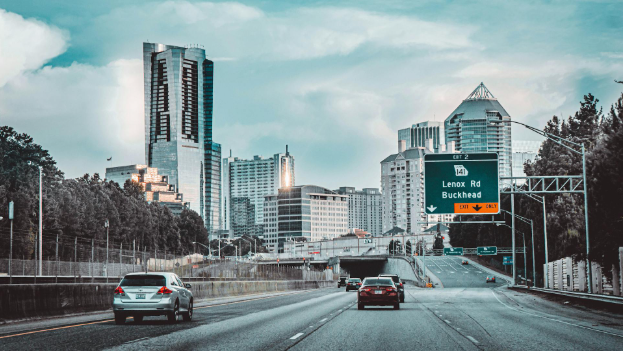
Atlanta doesn’t ease you in. From day one, the roads here demand a level of attention and quick decision-making that drivers coming from smaller cities aren’t always ready for. The interchanges are complex, the traffic pressure is real, and the gap between a smooth commute and a frustrating one can disappear in minutes depending on what’s happening on I-285 or the connector. All of that creates a driving environment where incidents don’t just happen to careless drivers – they happen to experienced ones who got caught in the wrong situation at the wrong moment. If you’re sorting through car insurance in Atlanta and want coverage that reflects what driving here actually looks like, these three factors are worth understanding clearly.
How Traffic Interaction Intensity Affects Driving Risk
Atlanta puts a lot of vehicles into close contact at high frequency, and that interaction intensity is where a significant share of the city’s incidents originates – not from reckless driving, but from the sheer volume of decisions required in dense conditions.
Frequent Vehicle Interaction and Lane Switching
On Atlanta’s busiest corridors – I-75 northbound in the morning, I-85 through Buckhead in the afternoon, the Connector at virtually any hour – drivers are constantly adjusting position relative to other vehicles. Every lane change is a small risk event. Most go fine. But the frequency of those maneuvers in a full Atlanta commute adds up in ways that a driver on a quiet suburban route simply doesn’t accumulate. Sideswipes from misjudged gaps, mirrors clipped during tight lane changes, slow-speed contact near ramp merge points – these are the consistent incident types that dense Atlanta traffic produces, and they show up in insurance data with a regularity that reflects the environment rather than individual driver quality.
Congestion and Close Proximity
Stop-and-go congestion on Atlanta’s expressways compresses the space between vehicles to a point where the recommended following distance essentially disappears. When you leave room, someone fills it. That’s not unique to Atlanta, but the duration of congestion here – stretches that stay backed up for an hour or more on bad days – means drivers spend extended time operating with less reaction buffer than safe driving guidelines assume. Rear-end incidents in slow traffic are the predictable output of that situation, and Atlanta’s congestion patterns create the conditions for them across a large portion of every weekday.
How Driving Time Pressure Influences Behavior
Time pressure changes how people drive in ways that are mostly invisible until something goes wrong. Atlanta’s traffic makes running late a routine experience, and the behavioral response to that pressure is one of the city’s more consistent risk factors.
Rushed Driving and Aggressive Decisions
A driver who’s already ten minutes behind and watching the clock approach a meeting time makes different choices than one with time to spare. The gap that’s probably big enough becomes the gap they take. The lane change that needs a little more room happens anyway. The yellow light that should have been a stop gets run. None of these feel reckless in the moment – they feel like reasonable responses to a time crunch. But they’re exactly the decisions that produce the kind of incidents that don’t seem like anyone’s fault until you trace back what actually happened. “I used to think Atlanta traffic just made me late,” says Denise K. Okafor, a marketing professional who commutes from Decatur to Midtown daily. “It took a fender-bender on Peachtree to make me realize how much my driving changed when I was running behind.”
Shortcuts and Risk-Taking
When the main routes are backed up, Atlanta drivers look for alternatives – side streets through residential neighborhoods, surface road shortcuts through commercial areas, routes that technically work but add their own complications. These shortcuts move drivers onto roads they use less frequently, where familiarity is lower and the unexpected is more likely. A driver cutting through East Atlanta Village side streets to avoid I-20 backup is navigating narrower roads, more pedestrian activity, and less predictable intersection behavior than they’d find on the highway. The shortcut solves the congestion problem but introduces a different set of variables. Drivers across Georgia deal with this trade-off in different forms depending on where they live, and the broader picture of car insurance in Georgia reflects how those varied driving environments contribute differently to individual risk profiles.
How Road Complexity Impacts Navigation Decisions
Atlanta’s highway network is genuinely complex. Spaghetti Junction alone has confused drivers for decades, and the rest of the metro’s interchange system isn’t far behind. That complexity produces navigation challenges that affect driving safety in specific, consistent ways.
Complex Intersections and Highway Networks
The interchange where I-85 and I-285 meet in the northeast corridor, the split decisions required on I-20 heading into downtown, the layered ramps around the GA-400 and I-285 intersection – these are not forgiving environments for a driver who isn’t sure which lane they need. Atlanta’s highway network was built over decades in layers that don’t always feel logically connected, and even experienced local drivers occasionally find themselves in the wrong lane at a critical decision point. Visitors and newer residents encounter this constantly. The behavioral response – hesitation, sudden lane changes, unexpected speed reduction – creates friction for every driver in the surrounding traffic.
Route Confusion and Decision Delays
When a driver isn’t sure where they’re going or realizes too late that they need to be in a different lane, the decision delay that follows is a real safety event. A vehicle that slows unexpectedly on an Atlanta expressway while the driver figures out the next move forces the cars behind it to react to something they weren’t anticipating. GPS helps, but it doesn’t eliminate the problem – instructions that come slightly late still produce late moves, and in dense Atlanta traffic a late move is a compressed-margin move. Georgia’s official driving and vehicle resource outlines state road rules that apply across these situations, but knowing the rules and confidently navigating Atlanta’s most complex interchanges are two different things. The drivers who handle them best have simply done it enough times that the decisions feel automatic – and the ones who haven’t yet are carrying real risk exposure every time the route takes them somewhere unfamiliar.
