

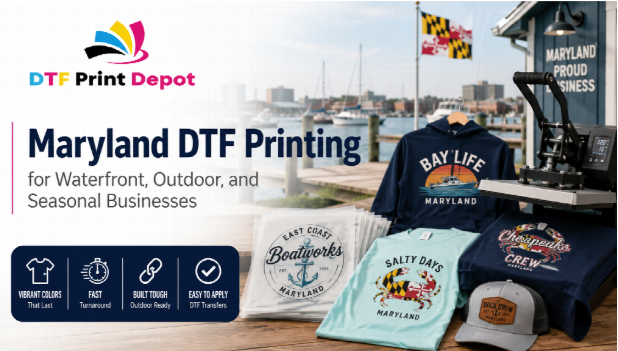
Maryland has a business environment that makes branded apparel more than a simple promotional purchase. From waterfront operators and marine service companies to outdoor recreation businesses, event vendors, restaurants, tour operators, clubs, and seasonal crews, many organizations need apparel that can change as quickly as their staffing, schedules, and customer-facing activities.
That creates a useful role for DTF printing.
Unlike an apparel program built around one large, fixed uniform order, many Maryland businesses need flexibility. A marina may need staff shirts before the boating season begins, a charter company may add crew members during its busiest weeks, an event organizer may need a limited run for a waterfront festival, and a local brand may want to test a new design before committing to a larger inventory.
For businesses comparingMaryland DTF printing options, the real question is therefore not simply how to print a logo on a shirt. It is how to create a branded apparel system that can respond to changing quantities, roles, designs, and deadlines.
Maryland’s Outdoor Economy Creates Diverse Apparel Demand
Maryland’s relationship with outdoor recreation is unusually important to the state economy. According to the Maryland Department of Natural Resources, outdoor recreation generated approximately $10.6 billion in value added in 2024 and supported about 85,000 jobs.
Fishing and boating alone contributed more than $700 million in value added.
Those numbers matter for apparel planning because the industry is not limited to boat owners. It includes businesses and organizations connected to marine services, waterfront hospitality, recreation, tourism, events, equipment, clubs, instruction, maintenance, retail, and customer experiences.
Each may have different apparel requirements.
A dock crew may need simple, highly visible branded shirts. A charter operator may want separate apparel for crew and customers. A waterfront restaurant may need staff garments that reinforce the brand without looking like promotional merchandise. A seasonal event vendor may need only enough shirts for a short operating window.
That variation favors an ordering system that can handle smaller production decisions without forcing every organization into the same format.
Start With the Role of the Garment
One of the most common mistakes in custom apparel is choosing the product before defining the job it needs to perform.
Instead, businesses should divide apparel into clear roles.
For example:
- everyday staff identification,
- customer-facing branded apparel,
- seasonal crew clothing,
- event merchandise,
- promotional giveaways,
- resale merchandise,
- limited-run campaign apparel.
A single organization may need several of these at the same time.
Once the role is clear, decisions about artwork size, garment type, quantity, placement, and reorder frequency become easier. A shirt intended for daily staff use should not necessarily be planned in the same way as a limited-edition design sold during a weekend event.
Avoid Ordering the Entire Season at Once
Seasonality creates another challenge for Maryland businesses.
Staff counts can change. Event attendance can change. New artwork may perform better than expected. A promotional idea that looks promising in March may no longer be relevant in July.
Buying every possible size and design at the beginning of a season can therefore create unnecessary inventory risk.
A more practical approach is to separate the first order from the expected total demand.
Businesses can begin with confirmed staff quantities, known events, or an initial merchandise test. Once actual demand becomes visible, they can reorder the designs and sizes that are moving.
This approach is especially useful for businesses that have several logos, multiple employee roles, or frequent seasonal changes.
Build Artwork for Reordering, Not Just the First Order
Repeatability is one of the most valuable parts of a good DTF workflow.
Before placing the first order, businesses should create a simple record for every approved design. That record can include:
- final artwork file,
- approved logo version,
- transfer dimensions,
- placement,
- garment type,
- garment color,
- intended department or use,
- previous quantity ordered.
This prevents the next order from becoming another design project.
It is also helpful when a seasonal employee joins late, one department needs additional shirts, or a successful merchandise design needs to be produced again.
The goal is to make the second order easier than the first.
Match Order Size to the Business Decision
There is no single ideal DTF quantity for every Maryland organization.
A marine repair business preparing uniforms for a permanent team may have predictable quantities. A waterfront festival vendor may have much less certainty. A small outdoor brand testing a new graphic has a completely different risk profile.
For that reason, the production quantity should follow the business decision.
If demand is uncertain, test first.
If a design is proven, reorder with more confidence.
If several designs are needed at once, organize them before production rather than treating each graphic as an unrelated job.
Businesses evaluating a local DTF printing service in Maryland should look for a workflow that supports those different scenarios instead of focusing only on the lowest unit cost.
Think Beyond a Single T-Shirt Order
DTF printing becomes more useful when it is treated as part of an apparel system rather than as a one-time purchase.
A waterfront business might have core staff branding that remains consistent throughout the year while changing secondary artwork for events or seasons. A recreation business may keep one logo but produce different placements or garment types depending on employee roles. A local merchandise seller may retain a few proven designs while testing new ones in smaller batches.
This structure makes it easier to protect brand consistency without locking the business into unnecessary inventory.
A Better Maryland DTF Strategy Is Flexible
Maryland’s waterfront and outdoor economy creates demand from businesses that often operate around seasons, events, changing crews, and variable customer traffic.
That makes flexibility important.
The strongest DTF ordering strategy is not necessarily the one with the largest first order. It is the one that gives the business a clear system for deciding what should be produced now, what should wait, and what should be easy to reorder later.
Businesses that define garment roles, organize artwork correctly, test uncertain demand, and document successful orders can turn DTF printing into a repeatable production tool rather than another source of excess inventory.
