

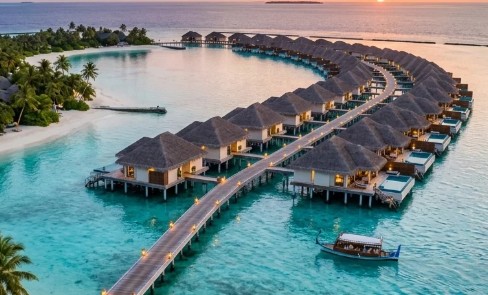
One island, one resort. That single rule explains almost everything about how a Maldives holiday works, and it is the part most first-time visitors from India do not understand until after they have booked.
There is no walking to another hotel. No stepping out for dinner. No changing your mind on day three. Whatever your island offers is the whole holiday, which makes the booking decision heavier here than anywhere else in the region.
Key takeaways
- Each resort occupies its own island, so the property is the destination.
- Board basis matters more than room type, because there is nowhere else to eat.
- Overwater villas suit couples better than families with young children.
- Distance from Malé determines transfer type, cost and arrival time.
- Family provision ranges from nothing to full-day programmes, and it is always stated.
The one-island rule and what follows from it
The Maldives is roughly 1,200 islands grouped into atolls. Resorts lease an island each and build the entire property on it.
This produces a holiday structure that has no equivalent in Goa, Kerala or Phuket. Your resort is not somewhere you stay while visiting a place. Your resort is the place.
For families, that changes the priority order at booking. Room quality drops down the list. What rises is whether the island has enough for children to do for the length of your stay.
Why the resort list narrows fast
A meaningful number of Maldives resorts are adults-only, and they say so clearly.
Of those that accept children, provision splits sharply. Some have a supervised club running most of the day with age brackets and trained staff. Others have a small play area and nothing more. Filtering for Maldives family resorts specifically removes most of the guesswork before you start comparing prices.
Board basis is the decision that costs the most
On a mainland holiday, half board versus room only is a preference. Here it is closer to a structural choice.
There are no restaurants outside the resort. Every meal, snack and drink for your family across the entire stay comes from the property, at resort pricing, with no alternative available at any price.
| Board basis | What it covers | Suits |
| Room only | Accommodation | Almost nobody in the Maldives |
| Half board | Breakfast and dinner | Couples eating light at lunch |
| Full board | All three meals | Families who drink little |
| All-inclusive | Meals, drinks, most activities | Families with children |
Families consistently underestimate this. Children eat and drink through the day, and a week of à la carte charges for four people reaches a number that dwarfs the difference between board levels at booking.
Villa type, and the overwater question
Overwater villas are the image that sells the Maldives. They are frequently the wrong choice for a family.
Most are built on stilts with direct water access and low or open railings. For a family with a child under about eight, that means constant supervision in a room where the floor gives way to open ocean.
What works better with children
Beach villas put you on sand, with a gradual entry into shallow water and space to leave things out.
Families with older children who swim confidently can consider overwater. Families with toddlers should book beach and accept that the photograph will be different.
Geography decides your arrival day
Resorts sit at varying distances from Velana International Airport at Malé, and that distance determines everything about the transfer.
Nearer resorts are reached by speedboat, which runs at any hour and takes 20 to 90 minutes. Distant resorts require a seaplane, which flies in daylight only and adds cost per person.
The practical consequence is arrival timing. A late-night landing from Delhi or Mumbai reaching a seaplane-only resort can mean an unplanned night in a Malé hotel, because the aircraft will not fly until morning. Resorts within speedboat range avoid that entirely.
Check this before you book flights
Confirm the transfer type and its operating hours before locking in your inbound flight, rather than afterwards.
This sequence catches people out regularly. The flight looks convenient, the resort looks ideal, and the two turn out to be incompatible on the same day.
What the resort actually runs for children
Family provision is worth interrogating rather than assuming, because the word “family-friendly” covers a wide range.
Ask three questions. What are the operating hours of the children’s club. What are the age brackets. Is it included in the rate or charged separately.
A club running through the day with proper age separation gives parents genuine time off. A club open for two hours after lunch does not, and the difference decides whether you return rested.
Food for Indian families
Larger resorts cater well for Indian visitors, with vegetarian options as standard and Indian dishes appearing on most buffets.
Jain and specific dietary requirements are usually manageable with advance notice rather than on arrival. Contact the resort directly once booked rather than relying on a note in the reservation system.
Buffet service handles children better than à la carte across a full week, which is another reason board basis and restaurant format deserve more attention than villa category.
Getting the sequence right
The order of decisions matters more here than the decisions themselves.
Start with whether the resort takes children and what it runs for them. Then board basis. Then transfer type and its operating hours. Then flights. Then villa category, which is the last thing that should influence the choice rather than the first.
Booked in that order, the Maldives works well for Indian families. Booked in reverse, which is how the marketing encourages you to approach it, you end up on a beautiful island that does not suit the people you brought with you.
