

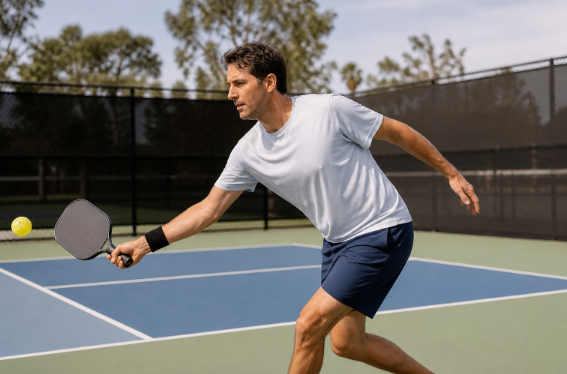
Pickleball asks for an unusual mix of standing still and moving suddenly. Rallies are short and played largely near the non-volley zone, so the work is lateral and repetitive rather than a sustained run. A shirt bought for the gym, or borrowed from a golf bag, was cut around a different pattern of motion, and the mismatch tends to show up at the armhole long before it shows up anywhere else. A collection of best pickleball shirts for men narrows the field, and the rest of the decision comes from knowing which parts of a shirt this particular sport loads.
That is a narrower question than general athletic advice usually answers. The paddle-side arm repeats overhead and reaching motions for the whole session, which loads the shoulder and the armhole far more than the torso, so pickleball shirts for men are best judged from the sleeve inward rather than from a chest measurement outward.
Fit and Fabric Checks for the best pickleball shirts for men
Start at the armhole. Every serve, every overhead and every stretch toward a ball at the line lifts the same arm through roughly the same arc, and the seam running around that armhole absorbs it. Raise the paddle hand as if to serve and hold it there. If the opposite side of the shirt travels with it, or the seam presses into the underarm, that pressure will repeat a few hundred times in a rotation of games.
Sleeve shape decides how noticeable the pressure becomes. A narrow opening grips the bicep and turns every reach into a small tug. A wide one moves air but can catch on the paddle arm at the top of a swing. Sleeve length works the same way: fabric ending exactly where the arm bends most is fabric folding against itself all evening. Small construction differences are easy to miss during a quick try-on. Repeat a serve, an overhead and a low stance; anything needing adjustment will soon identify itself clearly.
The torso has a smaller job here, and it is easy to overfit it.
Lateral steps, split steps and the low crouch at the non-volley line all pull a shirt down and sideways, while an overhead pulls it up. Controlled room through the body handles both. A very close cut clings once perspiration arrives, and an oversized one swings forward whenever the knees drop low. Torso length belongs to this check too, since a hem that lifts on every overhead becomes one more thing to fix between points.
Fabric is best judged against the session actually being played. Outdoor courts in summer reward a light shirt that does not gain weight when wet, because there is little shade between rallies and no real chance to dry out. Indoors the sun is gone, but the air often moves less, so a fabric that stays soft and does not turn heavy matters more than sun exposure does. Anyone splitting the week between both usually lands on something in the middle rather than the lightest option available.
Choosing pickleball shirts men Can Wear for Their Usual Sessions
Open play runs in rotations. A player comes off, waits a few minutes and goes back on, which produces several consecutive games with no realistic chance to change. A shirt that feels fine in game one and heavy by game three has failed a test no fitting room can reproduce, and that rhythm, more than any fabric description, is what separates court wear from gym wear.
Count the sessions before counting the shirts. A league three nights a week is a different order of demand from one relaxed Saturday morning. Three nights means each shirt has to be washed, dried and back in the bag on a short cycle, and players at that frequency usually settle on three or four they trust rather than one favorite and a drawer of spares. At one session a week, the arithmetic disappears, and personal preference can carry the decision instead.
Pickleball venues generally do not impose the collared-shirt requirement common at golf courses, and that widens the field. A crew neck, a v-neck and a polo are all ordinary on court, so the neckline becomes a comfort question rather than a rule to satisfy. Some players like a collar under a cap; others find any extra fabric at the throat warm once games start stacking up. Both answers are acceptable at most venues, which is not something a golfer choosing for the same afternoon can assume.
How men pickleball shirts Hold Up Through Longer Games
Most shirts feel similar for the first fifteen minutes. The differences arrive once the games begin stacking up: whether the sleeves keep turning around the arms, whether the neckline starts rubbing at the base of the throat, and whether the hem still returns to its place after each overhead. Those observations can only be gathered by playing, which is what makes men pickleball shirts hard to judge before a session.
Wear usually appears at the armhole before it appears anywhere else. A seam there can start to pull, or the stitching can go slack, while the fabric across the chest and back still looks new. That follows directly from where this sport puts its work, and it is worth turning a shirt inside out after a month of regular play to look at that seam specifically.
Buy one before buying three. Two or three real sessions reveal whether the sleeve, armhole and fabric recover well enough to justify ordering the same shirt again in another color later.
After that trial, the useful notes are specific:
- Where the shirt held moisture, and whether it stayed flat against the back or clung to it.
- Whether the armhole seam left any mark or soreness under the paddle arm.
- Whether the hem finished the session at the same height it started.
- How long the shirt took to dry once it came out of the bag.
Four answers, one session, and the second purchase stops being a guess.
